
Before You Build, Know Where You Stand
Every week, someone asks us: “Are we ready for AI?”
It’s the right question. Too many businesses jump into AI projects without understanding their starting point. They buy tools before knowing what problem they’re solving. They hire vendors before understanding what they actually need. They invest in infrastructure before mapping their data.
The result? Wasted budgets. Failed pilots. AI skepticism that delays real progress.
This self-assessment helps you evaluate where you actually stand—not where you hope you are or where a vendor told you that you are. Answer honestly. The goal isn’t to score well. The goal is to know what’s true so you can plan what’s next.
The Five Dimensions of AI Readiness
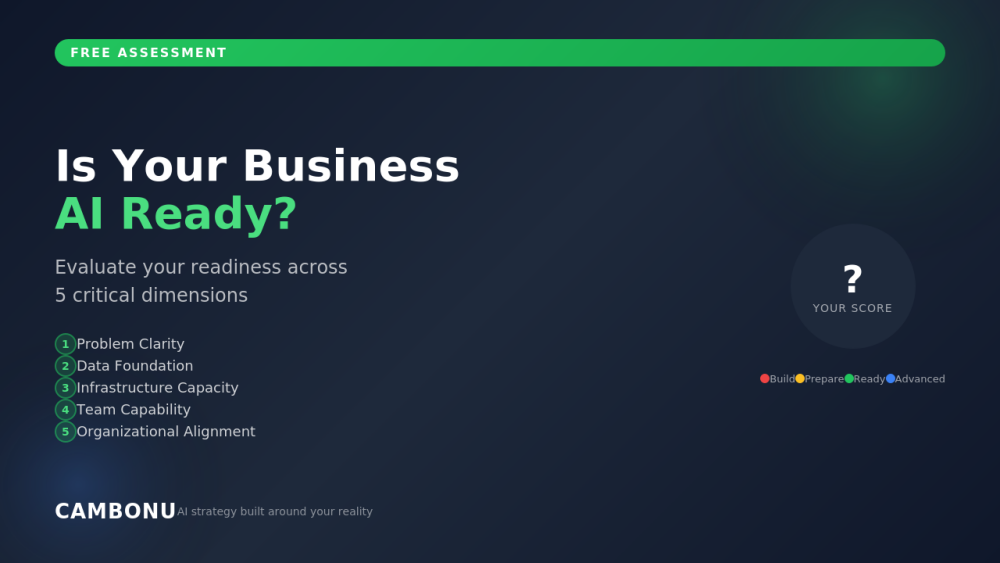
AI readiness isn’t one thing. It’s five:
- Problem Clarity — Do you know what you’re solving?
- Data Foundation — Is your data ready for AI?
- Infrastructure Capacity — Can your systems support AI?
- Team Capability — Do you have the right people?
- Organizational Alignment — Is your business ready to change?
Most failed AI projects score poorly on at least two of these. Most successful ones score adequately on all five.
Let’s assess each one.
Dimension 1: Problem Clarity
The Questions
1.1 Can you describe the problem AI would solve in one sentence?
- ❌ No — we’re exploring AI generally
- 🟡 Somewhat — we have several ideas but nothing specific
- ✅ Yes — we have a specific, well-defined problem
1.2 How do you currently solve this problem?
- ❌ We don’t — it’s not being addressed
- 🟡 Manually — people do it, but it’s slow/expensive/inconsistent
- ✅ Partially automated — but the current solution has clear limitations
1.3 What does success look like? Can you measure it?
- ❌ We’d know it when we see it
- 🟡 We have general goals (faster, cheaper, better)
- ✅ We have specific metrics (reduce X by Y%, save Z hours/week)
1.4 What’s the cost of NOT solving this problem?
- ❌ Unknown or minimal
- 🟡 Moderate ongoing cost
- ✅ Significant, quantifiable cost we can point to
What Your Answers Mean
Mostly ❌: Stop here. AI is a solution looking for a problem. Define the problem first—AI may not even be the answer.
Mostly 🟡: You have direction but need refinement. A strategy consultation can help sharpen the problem definition before you invest in solutions.
Mostly ✅: Strong foundation. You know what you’re solving and why it matters. Move to the next dimension.
Dimension 2: Data Foundation
The Questions
2.1 Where is the data AI would need?
- ❌ Scattered across systems, spreadsheets, email, paper
- 🟡 Mostly centralized but in different formats
- ✅ Centralized in accessible databases or systems
2.2 How clean is your data?
- ❌ Inconsistent — duplicates, missing fields, varying formats
- 🟡 Usable — some cleanup needed but manageable
- ✅ Clean — standardized, validated, well-maintained
2.3 How much relevant data do you have?
- ❌ Limited — less than 6 months or small sample sizes
- 🟡 Moderate — 1-2 years of relevant history
- ✅ Substantial — years of data with enough volume for patterns
2.4 Who owns the data? Can you use it?
- ❌ Unclear ownership, possible legal/contractual restrictions
- 🟡 We own it but haven’t verified compliance requirements
- ✅ Clear ownership, verified we can use it for AI purposes
2.5 Is the data sensitive? What are the privacy requirements?
- ❌ Highly sensitive (PII, health, financial) with strict regulations
- 🟡 Moderately sensitive with standard compliance needs
- ✅ Low sensitivity or we have compliant infrastructure already
What Your Answers Mean
Mostly ❌: Data work comes before AI work. Your first project isn’t AI—it’s data consolidation, cleaning, or governance. This isn’t failure; it’s the right sequence.
Mostly 🟡: Typical starting point for most businesses. Budget time and resources for data preparation as part of any AI project. Don’t let vendors skip this step.
Mostly ✅: Rare and valuable. Your data foundation is strong. You can focus on AI implementation rather than data remediation.
Dimension 3: Infrastructure Capacity
The Questions
3.1 Where does your data currently live?
- ❌ Local machines, personal drives, disconnected systems
- 🟡 On-premise servers or basic cloud storage
- ✅ Modern cloud infrastructure or well-maintained on-premise systems
3.2 What’s your technical infrastructure budget?
- ❌ Minimal — we avoid infrastructure spending
- 🟡 Moderate — we invest when necessary
- ✅ Adequate — we have budget for infrastructure improvements
3.3 Do you have deployment capabilities?
- ❌ No — we’d need to figure out how to deploy something
- 🟡 Basic — we can deploy simple applications
- ✅ Strong — we regularly deploy and maintain applications
3.4 What’s your preference: cloud or local AI?
- ❌ Haven’t thought about it
- 🟡 Prefer cloud for simplicity
- ✅ Have evaluated trade-offs for our specific situation
3.5 Can your current systems integrate with new tools?
- ❌ Legacy systems with limited integration options
- 🟡 Some APIs available but integration takes effort
- ✅ Modern systems with good API/integration capabilities
What Your Answers Mean
Mostly ❌: Infrastructure investment likely comes before or alongside AI. Factor this into timelines and budgets. Consider starting with cloud AI to prove value before building infrastructure.
Mostly 🟡: Typical enterprise situation. AI is feasible but plan for integration work. Cloud AI might be faster to start; local AI might be better long-term.
Mostly ✅: Infrastructure won’t be your bottleneck. You can evaluate AI options based on capability and cost rather than infrastructure constraints.
Dimension 4: Team Capability
The Questions
4.1 Do you have technical staff who could work with AI systems?
- ❌ No — we outsource all technical work
- 🟡 Limited — we have IT but no AI/ML experience
- ✅ Yes — we have developers or data people who could learn/adapt
4.2 Who would own an AI project internally?
- ❌ No clear owner — it would be “someone’s side project”
- 🟡 Potential owner but they’re already at capacity
- ✅ Clear owner with bandwidth and authority
4.3 Who would maintain an AI system after deployment?
- ❌ Unknown — we haven’t thought about ongoing maintenance
- 🟡 Probably the same team that builds it (vendor or internal)
- ✅ Defined maintenance plan with assigned responsibilities
4.4 What’s your team’s AI literacy?
- ❌ Low — AI is a black box to most people
- 🟡 Basic — general awareness but limited practical knowledge
- ✅ Moderate — understand capabilities, limitations, and concepts
4.5 How does your organization handle new technology adoption?
- ❌ Poorly — new tools sit unused, training doesn’t stick
- 🟡 Mixed — some adoption success, some failures
- ✅ Well — track record of successfully adopting new tools
What Your Answers Mean
Mostly ❌: Team development or external partnership needed. Don’t buy AI tools expecting self-service if nobody can operate them. Budget for training or managed services.
Mostly 🟡: Common situation. AI is feasible but include training, documentation, and change management in the project scope. Don’t underestimate the people side.
Mostly ✅: Your team can drive AI adoption. Focus on selecting the right solutions and providing support during transition.
Dimension 5: Organizational Alignment
The Questions
5.1 Does leadership support AI investment?
- ❌ No — skeptical or uninterested
- 🟡 Somewhat — open to it but not championing it
- ✅ Yes — actively interested and willing to invest
5.2 Is there budget allocated for AI initiatives?
- ❌ No — would need to find budget
- 🟡 Potential — budget could be allocated if justified
- ✅ Yes — budget exists or is earmarked
5.3 How will affected employees respond to AI?
- ❌ Likely resistance — fear of job loss or change
- 🟡 Mixed — some openness, some concern
- ✅ Positive — understand AI as a tool, not a threat
5.4 Are processes documented enough to automate?
- ❌ No — processes live in people’s heads
- 🟡 Partially — some documentation exists
- ✅ Yes — processes are documented and standardized
5.5 What happens when AI makes mistakes?
- ❌ Unknown — haven’t thought about error handling
- 🟡 Concern — mistakes would be problematic, need safeguards
- ✅ Planned — understand AI isn’t perfect, have review processes
What Your Answers Mean
Mostly ❌: Organizational readiness is low. AI projects will face resistance and resource constraints. Start with education and alignment before projects.
Mostly 🟡: Normal organizational friction. Plan for change management. Start with lower-stakes projects to build confidence before tackling core processes.
Mostly ✅: Organization is ready to adopt. Focus on selecting high-impact projects and executing well.
Calculating Your Overall Readiness
Score Each Dimension
Count your answers in each dimension:
| Symbol | Points |
|---|---|
| ✅ | 2 points |
| 🟡 | 1 point |
| ❌ | 0 points |
Dimension Scores
| Dimension | Questions | Max Score | Your Score |
|---|---|---|---|
| Problem Clarity | 4 | 8 | ___ |
| Data Foundation | 5 | 10 | ___ |
| Infrastructure | 5 | 10 | ___ |
| Team Capability | 5 | 10 | ___ |
| Organizational Alignment | 5 | 10 | ___ |
| TOTAL | 24 | 48 | ___ |
What Your Total Score Means
0-15: Foundation Building Phase
You’re not ready for AI projects—yet. That’s not failure; it’s information. Your next steps are foundational:
- Clarify business problems worth solving
- Consolidate and clean data
- Build basic technical capabilities
- Educate leadership and teams
Trying to skip this phase leads to expensive failures. Embrace it.
16-30: Preparation Phase
You have pieces in place but gaps remain. AI is feasible but requires careful planning:
- Start with bounded, lower-risk projects
- Address weak dimensions before scaling
- Build internal capability alongside external help
- Expect learning curves and plan accordingly
Most businesses land here. Success is possible with realistic expectations.
31-40: Ready Phase
Strong foundation across dimensions. You can pursue meaningful AI projects:
- Focus on high-impact use cases
- Evaluate build vs. buy based on strategic value
- Invest in projects that compound (infrastructure, capabilities, data)
- Consider local AI for strategic advantage
Don’t let readiness become complacency—execute while conditions are favorable.
41-48: Advanced Phase
Exceptional readiness. Rare and valuable position:
- Pursue ambitious, differentiating AI applications
- Build proprietary capabilities competitors can’t easily copy
- Consider AI as a core strategic advantage
- Move quickly—your readiness is a competitive asset
The Dimensions That Matter Most
Not all dimensions are equal for every situation.
If you’re exploring AI broadly: Problem Clarity matters most. Don’t invest until you know what you’re solving.
If you have a specific project in mind: Data Foundation and Infrastructure matter most. These determine feasibility.
If you’ve tried AI and failed: Team Capability and Organizational Alignment matter most. Technology wasn’t your problem.
If you’re choosing between vendors: All dimensions matter—but understand which ones the vendor addresses and which remain your responsibility.
What To Do With Your Assessment
If You Scored Low
Low scores aren’t bad news—they’re useful news. You now know what to work on before investing in AI:
- Pick one dimension to improve. Don’t try to fix everything at once.
- Set a timeline. “We’ll revisit AI readiness in 6 months after improving our data foundation.”
- Make it someone’s job. Readiness doesn’t improve without ownership.
If You Scored Medium
You’re in the normal range. AI is feasible but requires planning:
- Identify your weakest dimension. That’s where projects will struggle.
- Scope projects appropriately. Match ambition to readiness.
- Build capability as you go. Each project should improve your readiness for the next.
If You Scored High
Don’t waste your advantage:
- Move with urgency. Readiness is perishable—team members leave, priorities shift.
- Choose high-impact projects. You can handle them; don’t play it too safe.
- Build strategic assets. Proprietary AI capabilities that compound over time.
Ready For a Second Opinion?
Self-assessment has limits. We see what we want to see. We don’t know what we don’t know.
If you’ve completed this assessment and want an external perspective, that’s what our AI Strategy Consultation is for. In one hour, we’ll:
- Review your assessment together
- Identify blind spots you might have missed
- Discuss specific use cases for your situation
- Give you honest feedback on what’s realistic
- Create an actionable roadmap based on where you actually are
No sales pitch for services you don’t need. No cookie-cutter recommendations. Just an honest assessment and a practical plan.
Ready for an expert perspective on your AI readiness? Book a consultation to discuss your specific situation.
About Cambonu
We help businesses create practical AI adoption plans and custom AI applications tailored to their existing infrastructure, budget, and goals. No cookie-cutter solutions. No hype. Projects that actually work beyond the demo phase.

