
The Breakthrough Nobody Saw Coming
For years, the AI conversation was dominated by one assumption: serious AI requires serious cloud infrastructure. OpenAI, Anthropic, Google—the message was clear. Real AI lives in data centers. Your laptop? Not powerful enough. Your company servers? Too limited.
Then 2026 happened.
The models got smaller. The hardware got faster. And suddenly, the AI that used to require a $100,000/month API budget started running on a Mac Studio in someone’s office.
This isn’t a minor shift. It’s the difference between renting and owning. Between hoping your API provider doesn’t change their pricing and knowing exactly what your AI costs. Between trusting a third party with your data and keeping it on your own servers.
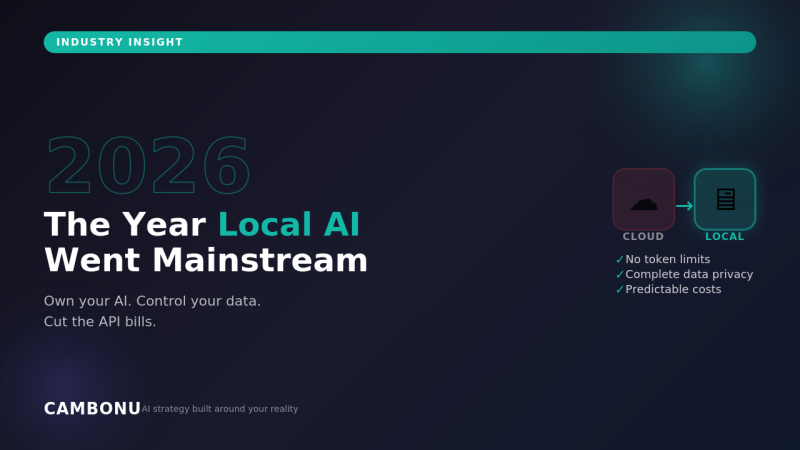
For businesses, 2026 is the year AI stopped being a cloud dependency and became infrastructure you control.
What Actually Changed?
The Models Shrunk Without Getting Dumber
In 2023-2024, running a capable language model locally meant compromises. The open-source models were noticeably worse than GPT-4 or Claude. You could run them locally, but why would you? The quality gap was too wide.
By late 2025, that gap closed dramatically. Models like Llama 3, Mistral, and their successors achieved near-parity with cloud APIs for most business tasks. Not for everything—frontier models still lead on complex reasoning and novel problems—but for the 90% of business use cases? Local models now deliver.
Document processing. Content transformation. Database queries. Research synthesis. Code generation. Classification and extraction. These aren’t edge cases. They’re the bulk of what businesses actually need AI to do.
The Hardware Became Accessible
Running a 70B parameter model used to require multiple high-end GPUs. Now it runs on a single workstation. Apple’s M-series chips put serious AI capability into machines that sit on a desk. NVIDIA’s RTX 40 and 50 series made local inference practical for Windows users.
The math changed. A $5,000 workstation running 24/7 costs less per query than API calls at scale—and the workstation is an asset you own, not a recurring expense that grows with usage.
Quantization and Optimization Matured
The technical breakthroughs in model compression finally hit production-ready status. 4-bit quantization. Speculative decoding. Flash attention. These aren’t research papers anymore—they’re standard practices that make local deployment practical.
The Cloud AI Problem Nobody Talks About
Here’s what we’ve observed working with businesses on AI adoption: cloud AI services optimize for their economics, not yours.
Token Limits Create Shortcuts
When every token costs money, systems are incentivized to cut corners. We’ve seen cloud-based agents that claim to “read” documents actually skim them with regex. Systems that should process full files instead sample a few sections. The optimization pressure is real, and it doesn’t favor thoroughness.
When AI runs locally with no per-token cost, there’s no incentive to cut corners. Process the full document. Run the verification step twice. Let the model think longer. The economics align with quality.
Data Leaves Your Control
Every API call sends your data to someone else’s servers. For many businesses, this isn’t just a preference issue—it’s a compliance issue. Healthcare data. Financial records. Customer information. Educational content. Legal documents.
“We use enterprise-grade security” doesn’t satisfy auditors who want to know exactly where data lives and who can access it. Local AI does.
Pricing Changes Without Warning
We’ve watched businesses build workflows around cloud AI only to see their costs triple when pricing changed. The dependency is real. When your operations rely on an external API, you’re one pricing update away from a budget crisis.
What Local AI Actually Looks Like in 2026
This isn’t theoretical. We’ve built and deployed local AI systems for real business problems. Here’s what’s actually running on client infrastructure right now:
Document Processing at Scale
The Problem: An educational technology company had thousands of scanned homework assignments and exams—valuable content trapped in paper format. Manual transcription would take months.
The Solution: We built EduDOM, an AI-powered document processing system that runs entirely on local infrastructure. Vision AI analyzes scanned documents, understands educational content structure, and outputs production-ready data for their database.
The Result: Documents that took 4-8 hours to transcribe manually now process in 2-5 minutes. No data leaves their servers. No per-document API costs. Complete audit trail for compliance.
It’s running in production, processing real documents, with humans reviewing the AI’s work through an interface designed for quality assurance.
Bulk Content Transformation
The Problem: A platform had accumulated 10,000 lessons over ten years, created with different tools by different people. The formatting was chaos—inconsistent HTML, Word artifacts, deprecated tags. They needed to standardize everything without changing any actual content.
The Solution: We built Perform Agent, a three-stage AI pipeline that analyzes content, transforms formatting, and verifies that zero content was altered. It runs locally, processes in parallel, and includes smart retry logic when the AI makes mistakes.
The Result: A 6-month manual project completed in 3 weeks. Every document verified unchanged at the text level. Original content preserved, formatting standardized.
The key insight: when AI runs locally, you can build verification steps that would be cost-prohibitive with API pricing. The AI checks its own work. If something seems wrong, it tries again with additional context. Quality isn’t constrained by token budgets.
Business Intelligence That Stays Private
The Problem: A company needed ongoing competitive intelligence—monitoring competitors, tracking industry trends, researching market opportunities. But their strategic questions and competitive focus were sensitive information they didn’t want flowing through external AI services.
The Solution: Research Agent runs entirely local. It searches the web, scrapes full articles, synthesizes findings, and builds a knowledge base over time. Scheduled research runs automatically. Reports generate with one click.
The Result: Institutional memory that compounds. Research from three months ago is searchable and connected to today’s questions. Strategic intelligence that never leaves the building.
Natural Language Database Access
The Problem: Data locked behind technical barriers. Only developers could query the database. Everyone else waited for reports.
The Solution: SQL Agent translates plain English into safe SQL queries. Ten layers of security validation ensure only approved queries run. Complete audit trail. Local processing.
The Result: Anyone can ask questions about their data. “How many customers signed up this month?” becomes an instant answer, not a ticket in someone’s queue.
The Real Advantages of Local AI
After deploying these systems, here’s what actually matters to businesses:
1. Predictable Costs
No per-token pricing. No surprise bills. A workstation costs what it costs. Electricity is measurable. The CFO can budget for AI without guessing at usage.
2. Unlimited Processing
When a document needs three passes instead of one, run three passes. When verification should happen twice, do it twice. When the right approach uses more tokens than the cheap approach, use more tokens.
Cloud economics push toward minimum viable processing. Local economics push toward maximum useful processing.
3. Complete Data Control
Know exactly where your data lives. Know exactly who can access it. Satisfy compliance requirements with certainty, not assurances.
For regulated industries—healthcare, finance, education, legal—this isn’t a nice-to-have. It’s often a requirement.
4. Customization Without Limits
Fine-tune models on your data. Adjust prompts without worrying about costs. Build workflows that would be prohibitively expensive with API pricing.
Local AI is yours to modify, optimize, and adapt.
5. No Vendor Lock-In
Switch models without rewriting everything. Try new approaches without new contracts. Own your AI infrastructure the way you own your other infrastructure.
Who Should Consider Local AI?
Local AI isn’t right for everyone. If you’re experimenting, cloud APIs are faster to start with. If your usage is light, the economics might favor pay-per-use. If you need absolute frontier capability for novel research problems, the biggest cloud models still lead.
But local AI makes sense when:
- Volume is high. Processing thousands of documents, queries, or requests where per-unit API costs add up.
- Data is sensitive. Healthcare, legal, financial, educational, or competitive information that shouldn’t leave your infrastructure.
- Compliance matters. Audit requirements that demand knowing exactly where data flows.
- Quality requires iteration. Workflows where verification, retry logic, and multiple passes improve outcomes.
- Budget predictability matters. Organizations that need to know AI costs in advance, not after the bill arrives.
- Customization is needed. Use cases that benefit from fine-tuning, specialized prompts, or domain-specific optimization.
The Shift Is Happening Now
2026 isn’t the year AI became possible. It’s the year AI became practical to own.
The cloud providers aren’t going away. For many use cases, they’re still the right choice. But the assumption that serious AI requires external infrastructure? That’s no longer true.
Businesses now have a choice: rent AI from providers who optimize for their economics, or build AI infrastructure that optimizes for yours.
The models are ready. The hardware is accessible. The tools exist.
The question is whether your AI strategy accounts for this shift—or assumes the 2024 landscape is permanent.
What This Means For Your Business
If you’re evaluating AI adoption, the local option deserves serious consideration. Not because cloud is bad, but because the trade-offs have changed. What was impossible in 2024 is practical in 2026.
We help businesses navigate this decision. Not with ideology about local versus cloud, but with honest assessment of what makes sense for your specific situation, infrastructure, budget, and goals.
Sometimes the answer is cloud. Sometimes it’s local. Often it’s hybrid—cloud for experimentation and edge cases, local for production workloads at scale.
The point is that you now have options. And understanding those options is the first step toward an AI strategy that actually works for your business.
Ready to explore what local AI could mean for your organization? Book a consultation to discuss your specific situation.
About Cambonu
We help businesses create practical AI adoption plans and custom AI applications tailored to their existing infrastructure, budget, and goals. No cookie-cutter solutions. No hype. Projects that actually work beyond the demo phase.

